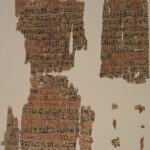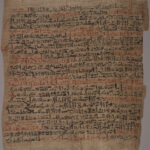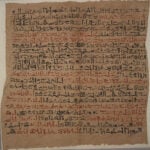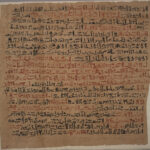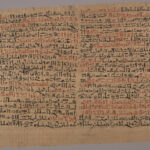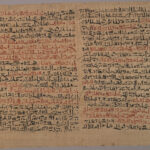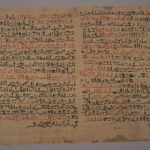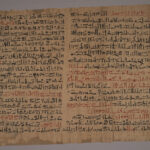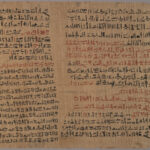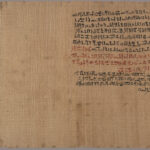
Edwin Smith Surgical Papyrus
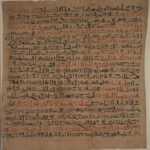
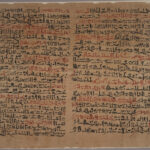
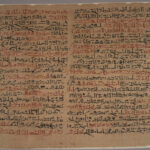
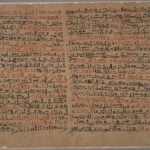
The Edwin Smith Surgical Papyrus is one of the oldest surviving medical texts, created in about 1600 B.C. It was written in Ancient Egypt’s hieratic script, which is a cursive form of Egyptian hieroglyphics.
The main text consists of 48 cases dealing with wounds and trauma. Each case is laid out using a carefully refined formula: a description of the injury, diagnosis, prognosis, treatment, and further explanations of the case which resemble footnotes. It stands out for its rational approach to medicine, which is unusual among surviving Egyptian medical texts.
On the opposite side of the papyrus are several magical spells and recipes, including one “for making an old man into a youth.”
When American Egyptologist Edwin Smith purchased the papyrus in Egypt in 1862 it consisted of a single long scroll about 15 feet long with some loose fragments. The text was divided into 17 columns, and at some moment during the 19th century it was cut apart into 10 leaves, some of which contain multiple columns, and several of which have writing on both sides.
After Smith died in 1906, his daughter donated the papyrus to the New York Historical, and it was loaned to the Brooklyn Museum in 1938, when the New York Historical loaned its collection of Egyptology materials to the museum. Both institutions together donated the papyrus to the library of the New York Academy of Medicine in 1948.
A facsimile, transliteration and translation of the papyrus by James Henry Breasted of the University of Chicago was published in 1930. A new translation by James P. Allen, a curator in the Department of Egyptian Art at the Metropolitan Museum of Art, was published in 2005.
Questions about higher resolution images of the papyrus and rights and permissions for the use of images of the papyrus should be sent to [email protected].
|
|
|
|
|
|
|
|
|
|
|
|
|
|
|
|
|
|
|
|
|