
By Pilar Pérez Cañizares, PhD, classical philologist based in Vienna, Austria, and the Library’s 2026 Paul Klemperer Fellow in the History of Medicine.
In the Hippocratic treatises of the late 5th and 4th centuries BCE, treating a patient very often meant cleansing the body. Many of them explain disease as an excess or corruption of the body’s fluids, above all phlegm and bile. Removing that excess was one of the physician’s chief tasks. The Hippocratic writings describe many ways of cleansing: bloodletting, enemas, fumigations, baths, laxative foods and drinks, and drugs poured into the nostrils to purge the head. The strongest means, however, were drugs that purged the body “upwards,” by vomiting, or “downwards,” through the bowels. The link is so close that the verb ‘pharmakeúein,’ literally ‘to give a drug’ (from ‘phármakon,’ or ‘drug’), is regularly used for purging.
The drugs themselves were powerful plants: white and black hellebore, scammony, spurges, squirting cucumber, and the berry of Cnidus, among others. Physicians knew how dangerous they were. A purge given at the wrong moment, in the wrong dose or to the wrong patient, could weaken the sick further or even kill them. Accordingly, the Hippocratic writings are full of rules. The Aphorisms advise purging matter that the body has “concocted” rather than matter that is still “raw” (Aphorisms 1.22)[1], and prefer upward purges in summer and downward purges in winter (Aphorisms 4.4). The treatises on diseases and on the diseases of women prescribe purges for one condition after another, often naming the drugs and the direction (e.g. On Internal Affections 25; Diseases of Women I 80).
Yet, the rules for purging are nowhere brought together in a systematic account. Instructions often give no quantities or other specifications, presumably because the procedures were so standardized that practitioners did not need them to be spelled out. Where drugs are named, their choice must have depended on the season and on what was available, which is why several alternatives are often offered. In On Internal Affections, a patient may be given “squirting cucumber, or the root of thapsia, or hellebore, or the juice of scammony” (On Internal Affections 18). The theory behind such prescriptions must be pieced together: when a purge was needed at all, how drugs were chosen, and how to judge whether the patient could bear it.
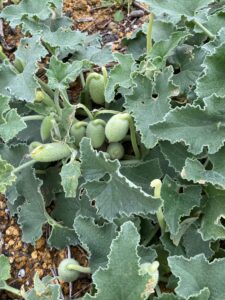
One text in the Hippocratic Collection does take drugs as its declared subject. It is known in Greek as Peri pharmakōn (Περὶ φαρμάκων) and in English as On Remedies. It survives only as a fragment of some 50 lines. It opens with a warning: “Matters concerning drugs are not what they are thought to be, since by the same drug people are both purged and not purged.” It goes on to treat foods as weaker drugs, to match the drug to the fluid in excess (bile, phlegm, water or black bile), and to insist that the physician question the patient before purging him. It ends by advising enemas instead of purgative drugs for patients with violent fevers, since enemas are less dangerous. The oldest manuscript introduces the text as an excerpt, “From Hippocrates’ Perì pharmakōn,” so its scribe knew he was copying part of a longer book.
What is that book? In my edition of another Hippocratic treatise, On Affections, I pointed out close parallels between the two texts: shared formulations and the same order of argument in which a scheme of drugs is followed by the questions a physician should put to the patient [2]. These parallels suggest that the longer work dealt with the theory of purgative drugs and, as the references to a book of drugs in On Affections indicate, was complemented by a collection of recipes and dietetic recommendations. Whether that theory was set out systematically, we cannot say. Even so, the treatises on diseases presuppose this body of knowledge, and the fragment preserves part of it. On Remedies offers a starting point for reconstructing that knowledge.
Thanks to the Paul Klemperer Fellowship, I was able to bring this question to New York Academy of Medicine in September 2026. New York Academy of Medicine holds a remarkable witness to the text. In the last printed page of its copy of the first Greek edition of Hippocrates (Venice: Aldine press, 1526) are two bound leaves on which a 16th-century reader copied On Remedies by hand. The printed volume claimed to contain the complete works of Hippocrates; its owner evidently thought otherwise. New York Academy of Medicine received this volume in 1928 with the collection of E. C. Streeter. The leaves went unnoticed until the late Paul Potter, to whom the study of Hippocratic medicine owes a great deal, came across them in 2019 [3].
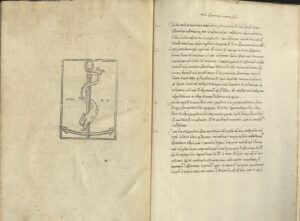
The discovery of a handwritten copy bound into a printed edition is significant because the Greek text has had an odd modern history. For most of the past century, research on it rested on a single manuscript in the Vatican Library, Urbinas graecus 64 [4] [5]. I began to establish how these copies relate to each other, to the Urbinas 64, and to the early printed editions, several of which New York Academy of Medicine also holds. Provisionally, the collation shows that the New York leaves descend from the Urbinas, through its direct copy made in the early 14th century, and now in the Ambrosian Library in Milan, and through at least one lost intermediate copy. Provisionally, the collation shows that the New York leaves descend from the Urbinas, through its direct copy made in the early 14th century and now in the Ambrosian Library in Milan, and through at least one lost intermediate copy.
The Greek fragment had a thin transmission. Editors did not know where to place it, as it entered the collected works of Hippocrates late, and Émile Littré left it out of his standard edition (1839–1861) because he doubted its origin. Its Latin translation, made in the 13th century and probably at the court of Manfred of Sicily, had the opposite fate [6]. It survives in more than 20 manuscripts, and from 1481 was printed with Rhazes’ Liber ad Almansorem, Maimonides’ Aphorisms and the Articella, the collection of texts on which medical students were trained. The Academy’s copy of the 1497 Aphorisms of Maimonides is one of these printings, and its shelves also hold the first Latin translation made from the Greek, by Iunius Paulus Crassus (Venice, 1537).
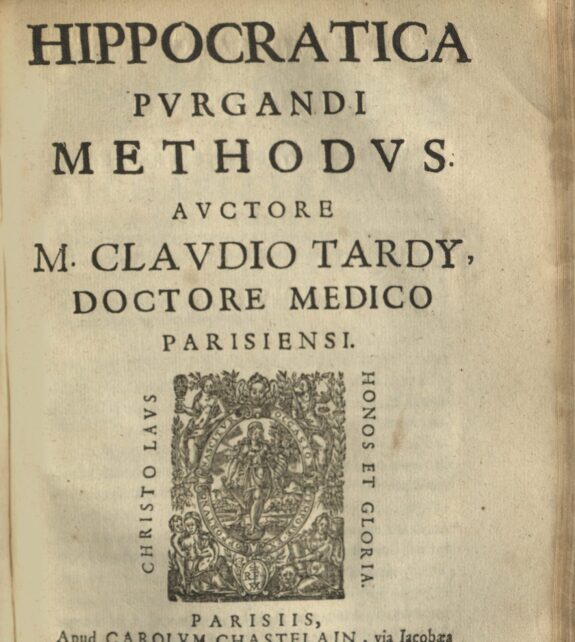
The interest in these few lines is easy to understand. Purging remained among the physician’s main therapies well into the modern period. Rufus of Ephesus wrote on purgative drugs, Galen on whom one should purge, and among New York Academy of Medicine’s books is a Hippocratica purgandi methodus, a “Hippocratic method of purging,” published in Paris in 1646. For centuries, physicians looked to Hippocrates for the rules of purging. The fragment On Remedies brings us closest to the place where those rules were first set out.
I am grateful to New York Academy of Medicine for the Paul Klemperer Fellowship, and to the staff of its library, particularly Arlene Shaner, for their help during my stay. I look forward to completing the edition in the coming year.
Sources:
[1] Hippocratic treatises are cited by chapter. Editions with English translations are available in the Loeb Classical Library (Hippocrates, 11 vols.); critical editions in the Corpus Medicorum Graecorum and the Collection des Universités de France.
[2]Pilar Pérez Cañizares, Hippocratis De affectionibus, CMG I 2,6 (Berlin: De Gruyter, 2024).
[3]Paul Potter, “New and Refound Manuscripts of the Hippocratic Medications,” in J. Jouanna, V. Boudon-Millot, A. Guardasole and N. Grimal (eds.), Histoire de la tradition et de l’édition des textes médicaux (Paris: Académie des Inscriptions et Belles-Lettres, 2025), 77–95.
[4]Hermann Schöne, “Hippokrates Περὶ φαρμάκων,” Rheinisches Museum 73 (1920–24): 434–448; see also Marie-Laure Monfort, “L’histoire moderne du fragment hippocratique Des remèdes,” Revue des études anciennes 102 (2000): 361–377.
[5]Hermann Diels, Die Handschriften der antiken Ärzte, I: Hippokrates und Galenos (Berlin, 1905), 49.
[6]Stefania Fortuna, “La tradizione latina di Galeno e il De farmaciis,” in O. Merisalo, M. Kuha and S. Niiranen (eds.), Transmission of Knowledge in the Late Middle Ages and the Renaissance (Turnhout: Brepols, 2019), 33–44; Pearl Kibre, Hippocrates Latinus, rev. ed. (New York: Fordham University Press, 1985), 165–167.