
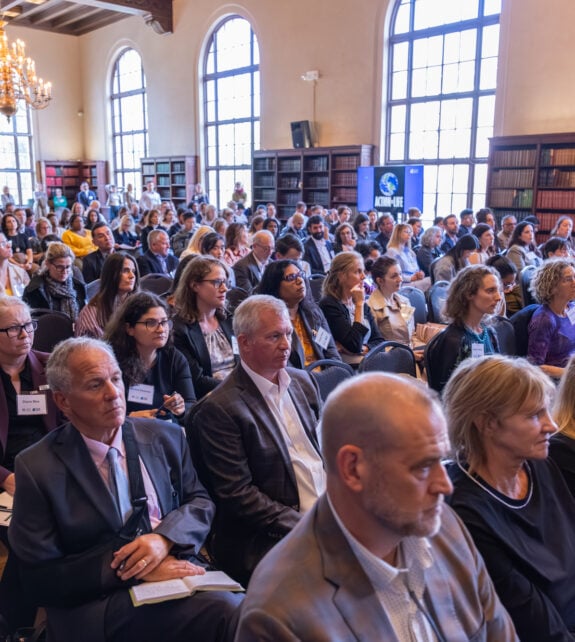
During Climate Week NYC, health and climate science leaders gathered at New York Academy of Medicine (NYAM). From pediatrician professors to atmospheric scientists, from New York City to the United Kingdom, the Climate and Health Commons captured the landscape of experts who are currently combating the climate crisis. NYAM and the National Academy of Medicine (NAM) co-hosted the convening.
Approximately 750 people registered for the event in-person. We are delighted to share a few of the important conversations held throughout the afternoon. A repeating theme throughout plenary and concurrent sessions was to think globally while acting locally, and to harness our spheres of influence to propel positive change where health and climate justice overlap.
Welcome Remarks and Opening Plenary: Health as Common Ground
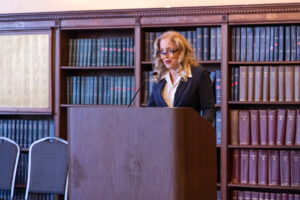
NYAM President and CEO Ann Kurth, PhD, CNM, MPH, provided opening remarks to start the Climate and Health Commons. Dr. Kurth emphasized the collective power of those assembled and tuning in via livestream.
“You’re taking action by being here today. You’re taking action every day in your work. Even in this very difficult time, those are green shoots,” she told the audience. “We can share our wisdom, we can share new strategies, and we’re forming our own learning community today.”
Dr. Kurth introduced the participants for the plenary:
- Moderator Judith Rodin, PhD, co-chair of NAM’s Climate and Health Initiative
- Omnia El Omrani, MD, director of programs with the Youth Climate Justice Fund
- Alaa Murabit, MD, senior global advisor at 500 Global
Much of the conversation among the three doctors revolved around financial government buy-in for climate and health initiatives, stewarding public trust, and some of the less visible impacts of the climate crisis.
“When we talk about health impacts, anxiety experienced because of climate change, (we can) get mental health care professions to see how to support those who are experiencing climate anxiety,” Dr. El Omrani explained when talking about the emotional toll of the climate crisis. “There are other mental health impacts from experiencing extreme weather events to PTSD (and) anxiety. Many farmers are experiencing a loss of crops, which (can) lead to suicidal ideation.”
Over the course of the multifaceted plenary that focused on unity, Dr. Murabit leaned into the leverage that we all wield individually. She stressed that none of us are powerless.
“All of us have a sphere of power,” Dr. Murabit said. “That might be our family; that might be our church. The first question I always ask people is, ‘What are you doing in your own sphere of power?’ How are you leveraging your influence, capital, knowledge, resources, your reach to be able to either educate people (or) to convene them?”
Concurrent Sessions Block 1: Climate-Smart Care, Education, Trust, and Solutions
The first of two concurrent session blocks featured four open sessions:
- Climate-Smart Care Pathways: Integrating Mitigation and Adaptation Across the Continuum of Care
- Embedding Climate and Health Education Across the Health Workforce
- The Trust Deficit: Equipping Health Professionals for the Climate Conversation Online
- Unlocking Healthcare’s Potential for Integrated Heat & Air Quality Solutions: The Cooperative’s Inaugural Innovation Forum
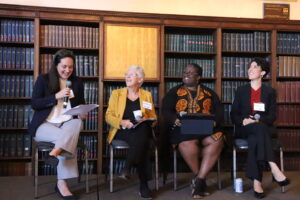 Moderators and speakers included experts such as Philip Dahlin, MPH, global director of sustainability at Johnson & Johnson; and Renee N. Salas, MD, MPH, MS, founding director of The Cooperative at Mass General Brigham.
A theme that emerged across several of these sessions was the need to cultivate and nurture public trust. During the session ‘The Trust Deficit: Equipping Health Professionals for the Climate Conversation Online,’ speakers addressed the need for public health officials to identify their intended audience.
“You ask a public health professional, ‘Who is this message for?’ And they’re like ‘The general public.’ You can’t call to action the general public,” said a smiling Brinleigh Murphy-Reuter, founder and CEO of Science to People. “Identify who you are trying to reach first, then you can design the CTAs around that.” Ms. Murphy-Reuter’s statement was made in the context of targeted communications during environmental crises.
Concurrent Sessions Block 2: Athlete Safety, the Federal Vacuum, AI Accountability, and Climate Resilience
The first of two concurrent session blocks featured four open sessions:
- Bridging the Gap: A Call to Action for National Heat Safety Standards to Help Parents and Coaches Keep Youth Athletes Safe
- Building Resilience in a Federal Vacuum
- Launch of Health Care Without Harm’s Artificial Intelligence (AI) Procurement Guide
- Trusted Messengers, Shared Learning and Climate Resilience: How Frontline Providers Turn Climate Knowledge into Action
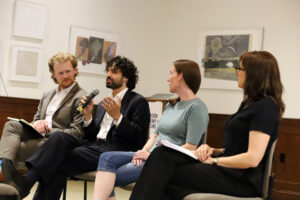 Moderators during these sessions included leaders like Almeta Cooper, national manager for health equity at Moms Clean Air Force, and Jenny Keroack, MPH, director of climate solutions at Health Care Without Harm. A theme that was presented across these sessions was accountability across the public and private sectors. This was especially pronounced during the session, ‘Launch of Health Care Without Harm’s Artificial Intelligence (AI) Procurement Guide.’ Chethan Sarabu, MD, assistant clinical professor at Weill Cornell Medicine, mentioned that it’s difficult to determine if an AI tool’s health benefits offsets drawbacks like energy use or environmental harm.
“There’re tools that health systems themselves are creating, and each of these have very different constraints and considerations from a footprint perspective. They might be powered by a different data center and have a different scale of operation,” Dr. Sarabu explained during a nuanced conversation. “There’s technology doing a lot of the grunt work, but it’s really about making sure we’re doing that in the most optimal way possible. We need more quantification. But to get to the quantification, I think we need a common structure that the whole sector can start to work and compare against.”
Closing Plenary: Protecting Community Well-Being in a Changing Climate
The event’s closing plenary captured the heart of the event: that a healthy climate benefits all communities both currently and into the future. This concluding conversation included:
- Moderator Katharine Hayhoe, PhD, chief scientist at The Nature Conservancy
- Shameika Hanson, climate adaptation specialist at The Nature Conservancy
- Liz Chatwin, VP of global sustainability and SHE at AstraZeneca
- Alonzo Plough, PhD, MPH, VP of research-evaluation-learning and chief science officer at Robert Wood Johnson Foundation
- Judith Rodin, PhD, co-chair of NAM’s Climate and Health Initiative
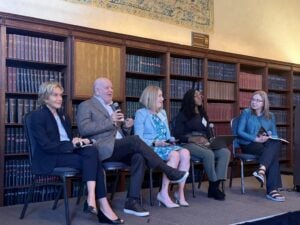 In a wide-ranging conversation, each speaker shared their expertise, experience, and empathy. Resilience in the face of the climate crisis provided an overarching theme for the five panelists.
“I would frame it this way: nature-based resilience should be thought of as a preventive health intervention,” Dr. Rodin said. “If we reduce people’s exposure to all of these vulnerabilities, whether it’s flooding, extreme heat or drought, air pollution… we can not only prevent illness of all sorts and premature death, but we can simultaneously protect an environment, build a community, and build natural capital.”
Dr. Plough leaned into Dr. Rodin’s comments using his own experience working in local communities across the U.S. He asserted that nuanced local solutions are necessary, and climate issues link neighboring communities.
“In the projects that we did, we both tried to figure out what it meant to develop a resilient community and awareness of the environmental risk that they face,” he explained when recounting his work in Boston, Seattle, and Los Angeles. “But not just in their community, but how the interdependency between these communities is essential for regional community.” Dr. Plough also stressed that historically, philanthropies have siloed themselves between health and climate. Fortunately, there has been a shift in the past few years to address the link between these two issues.
Healthier, Longer Lives for All
 While the climate crisis negatively impacts the health of the most disenfranchised, just like any other health equity challenge, it affects all of us. Heat waves increasingly happen everywhere, and over a wider range of the calendar. Rising sea levels don’t care how people vote and forever chemicals don’t care about your age, ethnicity, or other attributes.
At NYAM, our mission is simple but profound: healthier, longer lives for all. This ethos explains why we care so passionately about the climate crisis and its impact on our collective health. This year’s Climate and Health Commons was so important to us, but clearly to the hundreds of people who attended and the dozens who participated in plenaries and sessions. Thank you to everyone involved for showing up to advocate for health and climate action.