
New York Academy of Medicine (NYAM) is proud to work with many impactful organizations as partners and friends. For example, our Center for Healthy Aging works closely with five nonprofits known as Aging Technical Assistance & Resource Centers (TARCs). These agencies identify, support, and serve adults 55+ who are at enhanced risk of gaps in behavioral health and aging services. We recently met with representatives from these organizations for a conversation about what they do and how they work together:
 National Caucus for Black Aging (NCBA)
- Angela Bodie, director of health programs
- Angela Telesford, coordinator for health and wellness programs
Billie Tohee, National Indian Council on Aging (NICOA)
- Billy Tohee, executive director
- Scott Willie, TARC program director
National Hispanic Council on Aging (NHCOA)
- Christine Perez Jimenez, director of programs
Aging Services Inclusive of Asian American Networks (ASIAAN)
- Mansha Mirza, PhD, OTR/L professor in occupational therapy at the University of Illinois Chicago
Services and Advocacy for Gay, Lesbian, Bisexual, and Transgender Elders (SAGE)
- Sherrill Wayland, senior director of special initiatives and partnerships
We are deeply grateful for each of these organizations and their staff, whose work is advancing health equity in meaningful ways across communities.
A note: since this conversation took place between NYAM and the five OAEC TARCs, the first two broader questions and the final one will feature answers from all five organizations. For brevity, the majority of questions will feature answers from a couple of these organizations.
NYAM: How would you describe your organization in plain, simple language?
 NCBA: We serve as a Resource Center where older adults come to learn about how they could help themselves and advocate for themselves on health and wellness. We do have a job training program here and housing.
NICOA: We’re dedicated to advocating for the needs and rights of American Indian and Alaska Natives elders. We focus on health, social services, and the economic well-being of our Native elders. There are 575 tribal communities across the nation, and we aim to improve the comprehensive health, social services, and economic well-being of these elders.
NHCOA: We are a national organization, and our mission is to improve the lives of Latino older adults, their families, and caregivers. We are headquartered in Washington, D.C, but for more than 50 years, NHCOA has been a strong voice dedicating to promoting, educating, and advocating for different areas, such as research, public policy, economic security, health, caregiving, and also housing.
ASIAAN: We’re a bit unique in that we are housed at an academic institution that has scientific and scholarly expertise in topics related to aging, disability, and health promotion. Our resources can be used by older adults, caregivers, as well as service providers, to make their services more responsive to the needs of all communities.
SAGE: We lead in addressing the issues related to LGBTQ+ aging. We work by supporting advocacy, direct services, and fostering greater understanding around the rights and needs of LGBTQ plus elders across the country.
NYAM: What’s something about the community you serve that most people might not fully understand or appreciate?
 ASIAAN: Something that is often missed is that language needs among older AAPIs are layered. Many are part of a diaspora that is not fully comfortable in English but may also not be fully fluent in their language of origin either as it has faded over time. The other thing is they tend to live in intergenerational households, and language needs vary by generation. So, if you’re going to be covering topics or creating resources that are intended to be multi-generational, it’s something that you need to keep in mind.
SAGE: One of the things that I like to share about LGBTQ+ elders is we’re a part of all communities. People have thought that the LGBTQ+ community is largely a white, upper-class, segment of our population. We’re a part of all the communities represented within the resource centers here today. Statistically, we know that many of our LGBTQ+ elders are less likely to have children, and more likely to live alone. That creates an added layer of challenges when we think about aging and caregiving.
NYAM: What’s a program or initiative you’re most proud of right now? Something that’s really working?
NCBA: At NCBA, we’re most proud of our self-advocacy online. We started a webinar training series during COVID to address disinformation, and it took off like wildfire. We continue to look towards the series because it provides a platform for us to talk about (important topics).
 NHCOA: I want to highlight NHCOA’s Resource Center. It has become a multilingual hub that educates and empowers the Latino community with accurate information and resources that can help them stay healthy. What makes it especially effective is that it connects people to real resources, such as vaccines, housing, food banks, multilingual support, and others that can help them navigate complex systems right in a simple and accessible way.
NYAM: How does your organization’s approach to serving older adults look different from what mainstream aging services tend to offer? If there’s anything that you’ve had to build or adapt that didn’t exist before, we’re interested in learning about that.
NICOA: There’s barriers of technical issues as in our tribal communities. There are reservations in such remote areas that they may not have any internet connection. There are 575 tribal communities, and we have Native Americans in every state. We have to make sure that we can reach them.
We educate even our tribal elders and leaders about federal programs, such as Medicare, Medicaid, and the Older Americans Act. We’re in seven states where we assist elders 55 and older with finding employment.
ASIAAN: We try to customize all the resources and programs that we create for different communities rather than assuming everybody has the same needs and preferences. For the South Asian community, we heard that there’s a real lack of linguistically and culturally adapted resources on healthy eating and nutrition. So, we created something along those lines for them. Then, for the Cambodian community, we heard that a real pressing need was resources that encourage intergenerational dialogue and communication, so we created a resource for them.
If we are trying to engage older adults, we typically use plain language, lots of pictures, and create materials in a format that can be downloaded and printed out in hard copy. If we’re targeting younger service providers or younger caregivers, then we typically create online products like YouTube Shorts.
NYAM: What does it mean to meet people where they are? What does that actually require in your community, whether it’s culturally, linguistically, or geographically?
NCBA: We serve a burgeoning East African community, and that means we need to look toward hiring someone who speaks the language. It also might mean looking across the aging network at our partners to see who is there to help us as well. It also may mean looking totally outside of the aging network, public or private sector, who might be available to help us.
SAGE: When I first started this work, in 2010, one of the things I heard so often from aging providers was, “we don’t have LGBTQ+ elders in our community.” 
When I heard that, I knew that that wasn’t a true statement, it’s just that they didn’t see us. We had to meet the aging network where they were, helping them build awareness and understanding about the unique needs of LGBTQ+ elders. Today, we have a network of providers that do see us, that know we are a part of their communities, that know that we’re their employees, that know that we’re their neighbors.
NYAM: Before you were part of the collaborative, what felt like a gap, something you couldn’t do alone, that you hoped collaboration might help with?
NCBA: I appreciate being able to share and store our resources in one centralized hub. We do a lot of work on this particular grant, and it is worth sharing with the masses.
ASIAAN: We are a fairly new technical assistance and resource center. Everyone else has been super gracious in terms of sharing the history of the collaborative, as well as lessons that they’ve learned through trial and error, so we do not end up recreating the wheel.
The other thing that we’ve gained, that we were missing, is connections with some other national-level organizations, such as public health centers of excellence in aging and dementia research. Through those connections, we were able to invite panelists from those organizations to participate in our webinars.
NYAM: Has working alongside these other organizations changed how you think about your own community’s needs? Has another member’s work ever sparked a new idea or approach for you?
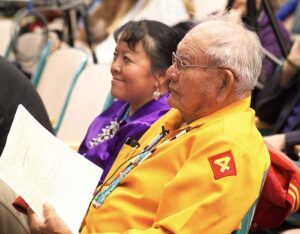 NICOA: The collaborators here have turned into very good friends and supporters. I feel that I can call on any of them. If I have an issue or concern, it’s so simple and so easy to get the encouragement that is needed to keep going full force in advocating for our elders.
NHCOA: For us, it has shown us that while every community is different, many of the same needs exist: caregiving support, language access, access to services, among many others. Learning from other members has also given us new ideas, just to improve our outreach and education efforts.
NYAM: Can each of you give a concrete example of something the Collaborative has made possible that wouldn’t have happened otherwise? It could be a resource, a connection, or even a shift in how your work is perceived.
ASIAAN: A joint presentation that SAGE did at the 2025 U.S. Aging Conference was the first for our center. It was really great to have someone handhold us through that experience. Also, that presentation was made possible by New York Academy of Medicine, because (they) led the abstract submission process.
SAGE: The presentation that we did, when the RAISE Family Caregiver Act was being developed, our collaborative was able to present to the committee. It was really important for our collaborative to be able to represent the diverse voices of elders across the country who may have otherwise been underrepresented.
NYAM: Five different communities are represented in this group. Where have you found surprising common ground? For example, shared challenges or solutions that might cut across all your communities?
 NICOA: Since I’ve been in this position with NICOA, I have learned so much about policymaking. Who do we approach? How do we approach them? When do we approach them? We all face a lot of the same challenges, the same barriers, the same hopes, the same goals represented in the five communities here.
NHCOA: I think a surprising amount of common ground exists around many topics like caregiving, social isolation, language access, transportation, and navigating complex health systems, among many others. Despite serving different communities, we often face similar barriers, and we can learn from each other’s culturally tailored solutions as well.
NYAM: Is there anything your community needs that you feel like the broader aging field is just starting to pay attention to? How does being part of this collaborative help you to push that conversation forward?
NCBA: AI technology isn’t going anywhere, and I think that we have to figure out how to take a deep dive into the next wave of technology so that we don’t get left behind.
SAGE: A lot of times the aging network thinks that there’s specific services across the country just for LGBTQ+ elders. There’s not. We need the aging network to continue to be at the table with us to truly meet the needs of the LGBTQ+ person in their community.
NYAM: Is there anything that we haven’t asked that you’d like to address, whether your specific role, organization, or your community?
 NICOA: NICOA advocates for the Native American and Alaska Native elders. That’s me. I’m an elder. I’ve used benefits all my life, such as Indian Health Services.
My TARC staff in the office, they’re young. I always ask them, when we talk about an issue, think about your relatives that are elders. What do they need? What would they like? What can they bring to our table? It has taken me back to my younger days. I just really appreciate them, and I hope that they can get to know all of you as well as I do.
ASIAAN: Yeah, I think we covered everything. That was a great set of questions. Thank you for this opportunity, and I also want to acknowledge the rest of the ASIAAN team; all that I have shared is only possible through team effort.