
Guest Blog by Leigh Alon, MD/PhD Student, Johns Hopkins University School of Medicine and the New York Academy of Medicine Library’s 2025 Paul Klemperer Fellow in the History of Medicine
One of the great joys (and perils) of archival research is that you never quite know what awaits until you walk through the door and open up that first box. My time at the New York Academy of Medicine was certainly no exception, and I feel incredibly lucky to have applied and received my fellowship before I even realized what a central role the materials would play in my dissertation.
My work focuses on how American Jewish physicians from the late 19th into the 21st century defined Jewishness in biological terms. That is, how did American Jewish physicians answer questions such as: Are Jews a race? Can biology determine who counts as Jewish? Are there Jewish diseases? While these responses were often in reaction to antisemitic ideas, Jews themselves were also deeply invested in finding satisfying answers for their own self-understanding and political ends.
To uncover what American Jewish physicians were thinking and writing about regarding Jewish biology, I have had to dive into the collections of both individual Jewish physicians, and Jewish institutions such as hospitals and social service organizations that provided medical care and/or partook in medical research. By scouring the online and printed catalogues at New York Academy of Medicine was able to find many materials that were of interest, from unpublished articles to formal reports, to whole books I had not yet encountered. Much of this material is not obviously about the topics I am interested in at first glance, but when I have dug into these physicians’ writings, I have found them to be suffused with theories about the Jewish body.
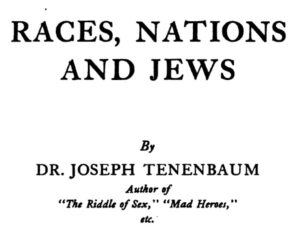
On the other hand, sometimes a source would hit me square in the face. That was the case with urologist Dr. Joseph Tenenbaum’s “Nations, Races, and Jews.” When I came across this title at New York Academy of Medicine, I could not believe I had not been aware of it sooner.
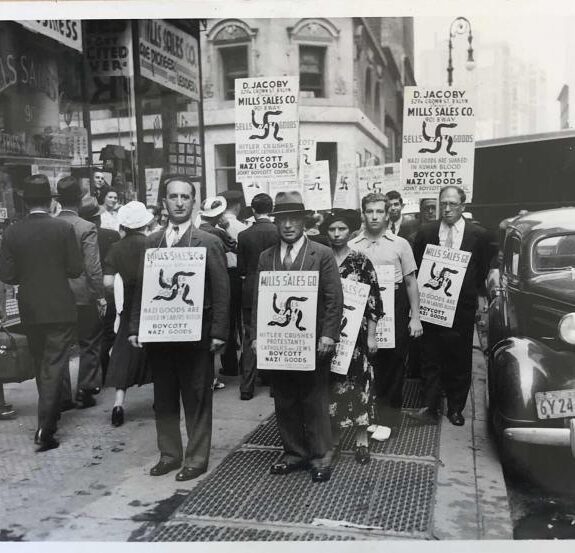
Joseph Tenenbaum, who was born in Poland in 1887 and immigrated to the United States in 1920, is perhaps better known for his anti-Nazi activism and representation of Polish Jewry. He led the American Federation of Polish Jews and was very active in the American Jewish Congress, eventually leading the Congress’s effort to boycott Nazi goods. As a part of the American Jewish Congress, Tenenbaum advocated for an idea of Jewish nationalism that advocated for self-governance in the diaspora, along with a Jewish cultural center in Palestine. As a physician, Tenenbaum also sought to leverage his medical expertise to make claims about the Jewish body. These were not claims made in isolation, but rather were part and parcel of his activism.
Tenenbaum drew largely on historical evidence to show that Jews were never a ‘race’ in the way that term is currently understood. He discussed the diversity of the Levant, where Jews originated, and then cited the existence of intermarriage laws in Europe as evidence that intermarriage was a frequent occurrence there too, in addition to more violent methods of racial mixing such as mass conversions and rape. He further cited Hitler’s more recent laws accounting for Germans with one Jewish grandparent as further proof of the high rates of intermarriage. Tenenbaum maintained that Jews differed among themselves to a higher degree than between them and their gentile countrymen. He wrote, “to speak under those conditions of Jewish race purity, even if there were such a thing as a Jewish race, is to carry delusion to conviction.” Tenenbaum went further to trouble the very concept of race. He described language as playing the role of a ‘trickster,’ allowing people to speak as if race held any meaning. Instead, Tenenbaum claimed that race is, “not static but dynamic” and is in fact, “nothing but a state of mind.” 1.
Tenenbaum squared his nationalism with his biological claims by clarifying that ’nationality signifies a state of mind, a feeling of solidarity, faith in and identification with history, traditions, and fate.”2. In other words, it did not matter whether Jews were a race, nor did it matter whether they shared a language or inhabited a specific territory. Their nationalism was legitimate by the very fact it existed.
In fact, Tenenbaum believed that it was this amorphous character of Jewish nationalism that could serve as a model for other nationalist movements. As opposed to Germany’s racial nationalism, Jews demonstrated that nationalism could be based on equality and liberal ideas, rather than racial exclusion and oppression. He cited the ideas of liberty and equality as, “Jewish articles of faith that form the backbone of Jewish nationality.” In this way, Tenenbaum’s discussion of Jewish biology allowed him to make a case both for Jewish nationalism as well as a broader argument about the possibility of a liberal nationalism. 3.
Through my dissertation research I have found that Tenenbaum was in good company among American Jewish physicians in the early 20th century. The vast majority of them, regardless of their stances on divisive issues such as Jewish nationalism, made the case that Jews were indistinguishable biologically from other peoples. Interestingly, and perhaps paradoxically, it was in the post-World War II period, as Jewish doctors sought to address Jewish genetic disease and trace Jewishness in the genome, that this discourse began to shift.
References:
1. Joseph Tenenbaum, “What’s in a Race?,” in Races, Nations and Jews (Bloch Publishing Company, 1934).
2. Joseph Tenenbaum, “The Rise of Nationalism,” in Races, Nations and Jews (Bloch Publishing Company, 1934).
3. Joseph Tenenbaum, “Nationalism, Supernationalism, and Anti-Semitism,” in Races, Nations and Jews (Bloch Publishing Company, 1934).