
By Guest Blogger, Silvia M. Marchiori
As the 2025 Audrey and William H. Helfand Fellow, I had the opportunity to explore New York Academy of Medicine’s extraordinary collections, and in a library at the crossroads of Fifth Avenue and 103rd Street, I learned about the instruments surgeons used nearly a thousand years ago in the Mediterranean world.
In the late 10th century, in the Caliphate of Córdoba (Spain), Abū al-Qāsim al-Zahrāwī, composed a highly influential treatise encompassing medicine, pharmacology, and surgery. His work drew on the legacy of ancient Greek authors, such as Hippocrates, Galen, Oribasius, and Paul of Aegina, whose writings circulated across the Mediterranean in papyrus rolls and parchment codices, traveling from Byzantium to Baghdad and onward to the Iberian Peninsula. A few centuries later, the scholar Gerard of Cremona (c.1114-1187) translated al-Zahrāwī’s surgical writings from Arabic into Latin, making this extensive body of operative knowledge accessible to European readers.
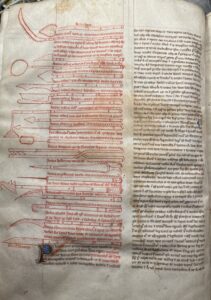
New York Academy of Medicine’s collections preserve a Latin copy of al-Zahrāwī’s surgical treatise, likely produced in England in the mid-thirteenth century. Dozens of red-ink illuminations embedded in the text depict the forms of surgical instruments, including cauteries, scalpels, forceps, and even a traction machine designed to treat fractures and dislocations. According to the author, images of instruments played a crucial role. In the section on diseased bones, for instance, he described different kinds of saws, scrapers, forceps, and blades (Fig. 1), explaining:
‘Now you should know that there are a great number of cutting instruments and saws for cutting these bones, varying according to the different sites and arrangements of the bones; their thickness or thinness; their greatness or smallness; their hardness or sponginess; so you should have ready for every sort of operation an instrument suitable for that operation. […] At the end of this chapter I give you illustrations of a number of instruments as types for you to copy and as a pattern upon which you can base others, God willing.’ (Translation in Al-Zahrāwī, On Surgery and Instruments: A Definitive Edition of the Arabic Text, English Translation and Commentary (Martin S. Spink e Geoffrey L. Lewis eds and trans.) (Berkeley: University of California Press, 1973), 564.)
Al-Zahrāwī deliberately included illustrations of surgical instruments, so that readers could copy them and use them as models for the development of new instruments. The actual use of these images, however, remains unclear, especially given difficulties in interpreting the instruments’ shapes and the lack of surviving medieval specimens for direct comparison. Historian Monica Green, for instance, has argued that medical practitioners in medieval Europe displayed their illuminated copies of al-Zahrāwī’s treatise to impress clients and patrons, rather than using them primarily as learning devices.
Al-Zahrāwī’s work nonetheless played a crucial role in inspiring new surgical treatises. Around the 1260s, the surgeon Guglielmo da Saliceto drew extensively on his writings to compose a surgical manual entitled Chirurgia, which circulated widely in both Latin and vernacular manuscript copies. Echoing al-Zahrāwī’s emphasis on surgical technologies, Saliceto devoted the final book of his treatise to the use of instruments, in particular cauteries, namely small metal tools heated to burn specific areas of the body to stop hemorrhages and to treat a range of conditions, such as migraine, epilepsy, sciatica, and hernias. Like al-Zahrāwī, Saliceto also argued that different types of cauteries were required for specific procedures and bodily parts. While ancient authors had described cauteries in great detail, they also proliferated their number unnecessarily. In contrast, Saliceto claimed that six cauteries were sufficient to perform all operations, and he complemented textual instructions with images to help readers visualize their shape.
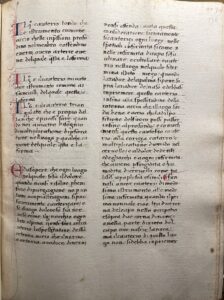
Manuscripts of Saliceto’s Chirurgia were supposed to include images, but in many copies, the compilers left blank spaces to include images that were never added, as in the case of the two following manuscripts. The Italian translation of Saliceto’s treatise in the NYAM collections (Fig. 2) displays evident similarities with another manuscript in the Biblioteca Nazionale Marciana in Venice (Fig. 3), including blank spaces for the missing images of cauteries. Although the transmission of this text remains uncertain, tracing connections between different copies can provide clues to a common origin.
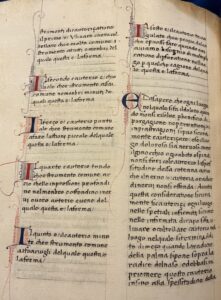
Linguistic features and graphic elements, such as handwriting and the rubrication style in blue and red ink, suggest that these two copies likely originated in the same scriptorium, possibly in Bologna or Padua, where the university offered a prestigious medical education to students from across Europe.
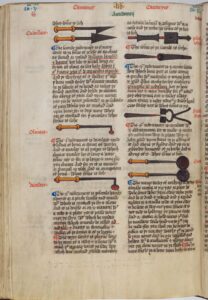
The circulation of texts by al-Zahrāwī and Saliceto inspired other medical authors, among them the influential surgeon and papal physician Guy de Chauliac (1300-1368). Numerous copies of his surgical treatise include images of instruments embedded in the text, as exemplified by the New York Academy of Medicine manuscript The Inventorie or the Collectorye in Cirurgicale Parte of Medicene, an English translation of Guy’s work dated to the 14th or 15th century. Following Saliceto, Guy described only six types of cauteries, although he revised their names and forms (Fig. 4).
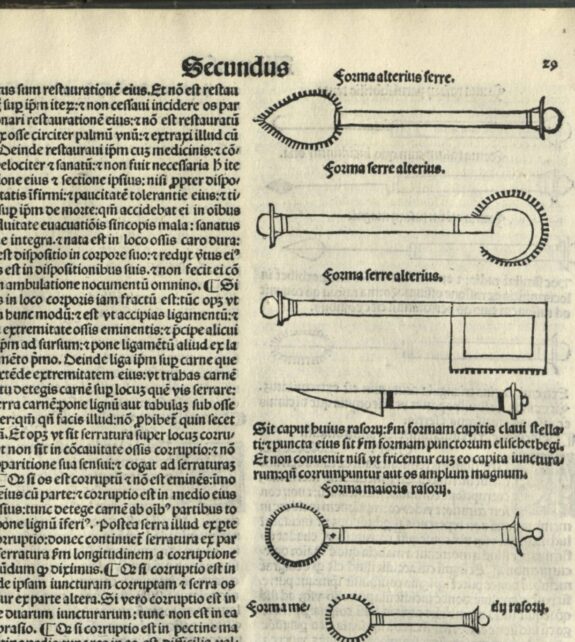
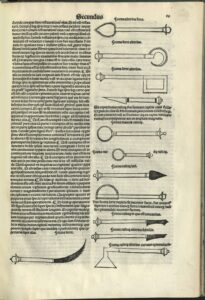
This manuscript tradition informed the composition of the first surgical manuals in print. An abridged version of Guy de Chauliac’s treatise was published in Venice in 1501, alongside al-Zahrāwī’s work and two ophthalmological treatises of Arabic origin. In this volume, the editor translated into woodcuts the illuminations that had accompanied al-Zahrāwī’s text in manuscript, while retaining their essential shapes and positions within the text (Fig. 5).
When read together, these books reveal the story of the long-term transmission of surgical knowledge across time, space, and cultures, connecting the heritage of ancient authors to medieval practices of translation from Arabic into Latin and the European vernaculars, and revealing how surgical expertise was preserved and adapted for new audiences. In parallel, they draw attention to the complex interplay between texts, images, and the realities of surgical practice, raising important questions about how illuminations of instruments functioned as pedagogical tools, symbols of professional authority, or models for the making of actual instruments.
FURTHER READINGS
Lawrence Bliquez, The Tools of Asclepius: Surgical Instruments in Greek and Roman Times (Leiden: Brill, 2015).
Monica H. Green, ‘Moving from Philology to Social History: The Circulation and Uses of Albucasis’s Latin Surgery in the Middle Ages’, in Florence Eliza Glaze and Brian Nance (eds), Between Text and Patient: The Medical Enterprise in Medieval and Early Modern Europe (Florence: SISMEL/Edizioni del Galluzzo, 2011), 331–72.
Emily Savage-Smith, ‘The Practice of Surgery in Islamic Lands: Myth and Reality’, Social History of Medicine, 13.2 (2000): 307–21.
Michael McVaugh, The Rational Surgery of the Middle Ages (Florence: SISMEL/Edizioni del Galluzzo, 2006).